Unapologetic Black Power in the South

… I heard so many people after the Georgia runoff in which Raphael Warnock defeated Herschel Walker who said some version of “Yes, but it was still too close.”

It seemed to me that those comments — and many others — missed the bigger point: Something absolutely historic is happening in Georgia that portends a massive political realignment for several Southern states. Georgia voters proved this year that the historic election of a Black senator from a Southern state by a coalition led in many ways by Black people was not a fluke. …

Georgia Republicans thought they could fracture the Black vote. They couldn’t. It held strong and united.

There is a great, nearly inexpressible exhilaration in this realization as a Black citizen and voter. Black people and other minorities weren’t simply being called upon to tip the balance when white voters split down the middle. Every other Black senator in American history has been elected by a coalition led by white liberals. Warnock is the first elected by a coalition led by Black people. CONTINUED

Charles M. Blow, New York Times


The OPINION TODAY email newsletter is a concise daily rundown of significant new poll results and insightful analysis. It’s FREE. Sign up here: opiniontoday.substack

2022 counties: Who voted, who didn’t and why candidates matter

This week’s Senate runoff win by Democrat Raphael Warnock in Georgia marked the official end of the 2022 mid-term election. And with that, the Data Download takes a look at what we learned from some of our County to County locales in this cycle.

Going into 2022, the NBC News team turned its focus to a set of counties to examine how different segments of the electorate — African-American voters, evangelical voters, college town voters and different kinds of Republicans — would respond to the campaign. As we noted recently, the lessons of 2022 varied depending on the state, but the County to County communities showed some revealing trends. CONTINUED

Dante Chinni, NBC News


The OPINION TODAY email newsletter is a concise daily rundown of significant new poll results and insightful analysis. It’s FREE. Sign up here: opiniontoday.substack

How Kyrsten Sinema’s decision makes Democrats’ 2024 Senate map tighter

Arizona Sen. Kyrsten Sinema decided to shake up the political world on Friday by becoming an independent. The former Democrat is still caucusing with the party in the Senate, so the Democratic caucus still has 51 members. Now, instead of 49 Democrats and two independents within their ranks, the caucus has 48 Democrats and three independents.

But that simple math hides a more clouded picture for Democrats and for Sinema herself. Sinema’s interests are no longer necessarily the Democrats’ best interests in the next Congress, and the 2024 Senate map became even more complicated for Democrats with Sinema’s decision. CONTINUED

Harry Enten, CNN


The OPINION TODAY email newsletter is a concise daily rundown of significant new poll results and insightful analysis. It’s FREE. Sign up here: opiniontoday.substack

Near record-high numbers of young people voted during the midterms, signaling a possible shift – or exception – in voting trends

People line up to cast early ballots during the 2022 election at the University of Michigan. Jeff Kowalsky/AFP via Getty Images
Abby Kiesa, Tufts University

The November 2022 midterms have come and gone, but there are still some potential lasting implications that could influence the next election season.

One is that young people, aged 18 to 29, had one of the highest voter turnouts in a midterm election in recent history, according to our early analysis.

Specifically, an estimated 27% of eligible voters in that age group turned out to the polls in 2022, according to research by my team at CIRCLE – a research group at Tufts University focused on youth civic engagement. This marks only the second time in the last 30 years that more than 1 in 4 voters under 30 voted in a midterm cycle. In 2018, approximately 31% of young people voted.

It was young people’s support for Democratic candidates, specifically, that led them to have a major impact on elections in key states this year. Their votes were influential or outright decisive in several close races won by Democrats, such as Nevada’s senate election. The same was true in the Georgia senate and Arizona gubernatorial races.

Voter turnout across all age groups tends to be significantly lower in midterm elections than in presidential elections.

Young people, though, have historically voted at even lower rates than older adults in general. This trend has begun to change, with double-digit increases in youth turnout between 2014 and 2018 and between 2016 and 2020.

As a scholar of young people’s participation in democracy, I think the youth vote in 2022 underscores much of what works to increase young people’s electoral participation.

More registration, more votes

For starters, there was higher youth voter registration in 2022 than in 2018 in many states, including Michigan, Nevada and Kansas. Young political and civic leaders and voters also connected to issues that affect their lives – like abortion rights – in this election.

These trends also highlight what could help lessen ongoing challenges to get more young people to vote. There are voting laws, for example, that make it easier to register and vote.

Three young women wear face masks and hold yellow sweatshirts up to them that say 'count every vote'
Young people typically are less likely than older people to vote in both presidential and midterm elections. Aaron Jackendoff/SOPA Images/LightRocket via Getty Images

What happened in November 2022

The overall 27% youth turnout rate is only one part of the story.

This was the 10th election cycle in a row in which 18- to 29-year-olds supported Democratic House candidates by at least a 10-point margin, according to CIRCLE’s analysis of the Edison Research data.

This year, young voters preferred Democratic House candidates by a 28-point margin. Youth of color, young women and LGBTQ youth supported Democrats by an even wider margin.

Young voters’ preference at the polls was markedly different from that of other age groups. Nationally, voters ages 30 to 44 preferred House Democrats by only 4 percentage points, and voters over the age of 65 preferred House Republicans by more than 10 points.

Why did it happen

Many reporters have asked me and my colleagues who contributed to this article – including Alberto Medina, CIRCLE’s communications team lead, and Ruby Belle Booth, CIRCLE’s elections coordinator – why youth voter turnout dropped in 2022 below the 2018 levels.

Throughout 2022, there were some signs that youth participation in the midterms would be relatively strong, including the number of young people already registered to vote. However, in that same analysis, my colleagues and I found that voter registration among 18- and 19-year-olds was lagging compared to 2018.

Supporting these young people to vote remains an enduring challenge.

Many campaigns and organizations rely on the existing voter rolls and other lists of registered voters to conduct outreach, so they often miss these potential new voters. That’s compounded by another issue: Young people are less inclined than other voters to identify or register with a political party.

Politics is personal

Instead, many young people approach politics based on the issues they care about.

In 2018, for example, the Parkland, Florida, school shooting, which killed 17 people, led more young people to vote for candidates they felt would do more to curb gun violence.

A number of high-profile climate change protests in 2020 also appeared to boost youth voter turnout that year.

In 2020, many young voters focused on racial justice and the Black Lives Matter movement, following the May 2020 police killing of George Floyd, a 46-year-old Black man. That spurred considerable political engagement, like participating in public protests, that connected to a major increase in youth voter turnout between 2016 and 2020.

In 2022, young people continued to push for change on issues they consider personal, like climate change, gun violence and racial justice.

And after the Supreme Court’s reversal of Roe v. Wade in June 2022, abortion rose to the top of young people’s issues of concern.

While nearly 3 in 4 young people said they favor legal abortion, both young people who are for and against abortion rights said this was a top issue for them.

Our analysis of exit poll data found that young voters were the only age group to cite abortion as their top reason for voting. Other groups of voters over 30 said that inflation was their top priority.

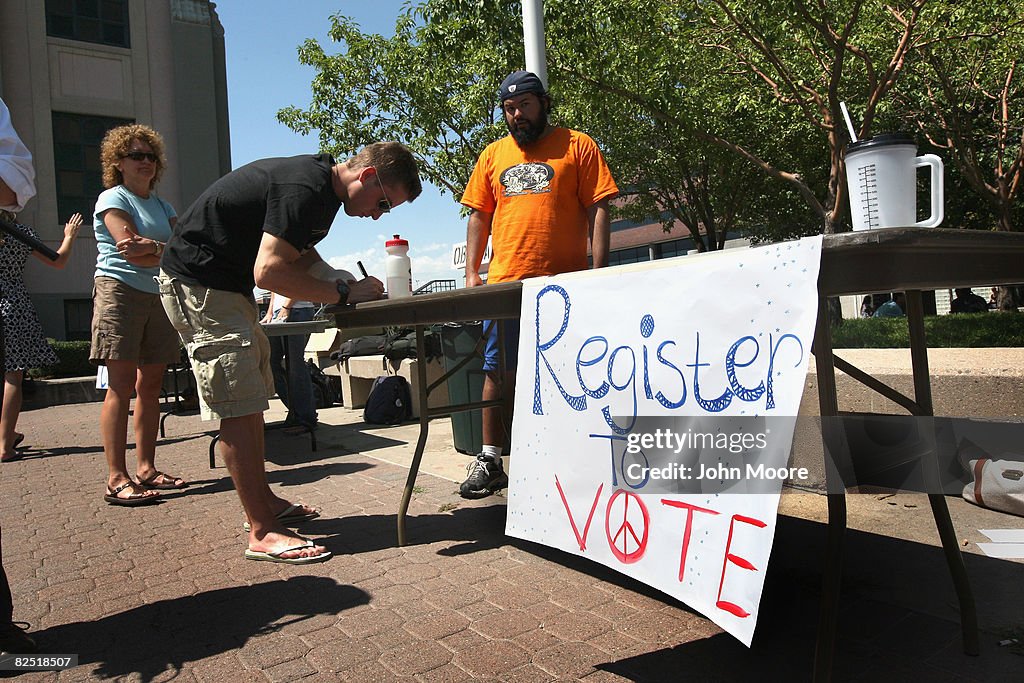
A man in an orange shirt stands next to a table outdoors with a sign that says 'register to vote' while another man leans over the table, filing out paperwork.
Voter turnout among young people has historically been low, in both midterm and presidential elections. John Moore/Getty Images

Implications for 2024 and beyond

Millions more young people born after 1996 will reach voting age by 2024. Their political power will only grow in the years to come, while those over the age of 65 will make up a declining share of the population and the electorate.

What that shift means for election results will depend on how political parties and other political and civic groups engage young people.

In recent years, most young people have voted for Democrats. This is a shift from just 20 years ago, when voters under 30 split their vote fairly evenly between Democrat and Republican candidates.

But Republicans lag behind Democrats when it comes to directly communicating with young people. Just less than 1 in 3 people aged 18 to 29 said they heard from the Republican Party or the Donald Trump campaign in the month before Election Day in 2020. Half of young people, conversely, said they heard from the Democratic Party or Joe Biden’s campaign.

There are other actions and policies that could get more people under 30 to the polls.

Preregistration, which allows young people to register to vote at age 16 so they’re ready to cast a ballot once they turn 18, can increase youth turnout, but it’s only available in 16 states. Other policies and efforts by election administrators to get more young people to vote can vary widely across states, leading to major differences in participation. In 2020, youth turnout varied from 32% in South Dakota to 67% in New Jersey.

Young people’s estimated 27% turnout rate in 2022 marks a near-record for an age group that has historically participated at lower rates in midterm elections. Whether this is a long-term trend or not will depend on whether communities and political groups implement the changes that research suggests can lead to sustained increases in youth voter turnout.The Conversation


Abby Kiesa, Deputy Director at CIRCLE, Tufts University

This article is republished from The Conversation under a Creative Commons license. Read the original article.


The OPINION TODAY email newsletter is a concise daily rundown of significant new poll results and insightful analysis. It’s FREE. Sign up here: opiniontoday.substack

Many around the world feel the system is broken. Can we do anything?

Over the past few years, there has been a string of populist victories. From Brexit in 2015 to Trump’s victory in 2016, they have been the canary in the coal mine for surging anti-establishment sentiments worldwide.

Following these two earth-shattering wins, anti-establishment candidates continued their victory march in places like Mexico, Brazil, France, Poland, and Hungary, to name just a few. These political movements cut across party lines—with candidates emerging on the right and left who adhere to these ideals. What’s underling all these disparate candidates, parties, and simmering political rage? One simple but potent idea: the system is broken.

Ipsos runs a global index to measure this phenomenon, how it’s shifted overtime, and what might take the edge off some of the more hard-lined and prevalent beliefs here. CONTINUED

Clifford Young & Sarah Feldman, Ipsos


The OPINION TODAY email newsletter is a concise daily rundown of significant new poll results and insightful analysis. It’s FREE. Sign up here: opiniontoday.substack

CNN Poll: Views of the state of the country are slightly improved, but Americans’ economic concerns remain

Americans’ views of the state of the nation have bounced back slightly since earlier this year, a new CNN poll conducted by SSRS finds, but public perception of the economy remains grim. Nearly half of Americans say they’re financially worse off than they were a year ago, the survey finds, with more than 90% expressing concerns about the cost of living and the majority cutting expenses in response. …

President Joe Biden’s job approval rating stands at 46%, with 54% disapproving – still underwater, but up from 41% who approved in late October. They are his strongest numbers in CNN polling since a year ago, when 49% said they approved in December 2021. CONTINUED

Jennifer Agiesta & Ariel Edwards-Levy, CNN


The OPINION TODAY email newsletter is a concise daily rundown of significant new poll results and insightful analysis. It’s FREE. Sign up here: opiniontoday.substack