Your political rivals aren’t as bad as you think – here’s how misunderstandings amplify hostility

Misunderstanding can play a role in people’s dislike of others who have different beliefs. wildpixel/Getty Images
Daniel F. Stone, Bowdoin College

U.S. Rep. Marjorie Taylor Greene drew raised eyebrows when she suggested on Presidents Day that the United States pursue a “national divorce.”

Even in an era of seemingly ever-growing political polarization – and despite Taylor Greene’s record of making controversial statements – the proposal shocked members of both political parties.

“The last thing I ever want to see in America is a civil war. Everyone I know would never want that – but it’s going that direction, and we have to do something about it,” Taylor Greene said in a follow-up interview.

“Everyone I talk to is fed up with being bullied by the left, abused by the left, and disrespected by the left.”

It seems safe to say that most left-leaning people would be puzzled by these accusations. And Taylor Greene certainly didn’t indicate that she understands the left’s perspective on causes of U.S. political conflict.

It’s intuitive that misunderstandings – like these – and hostility often go hand in hand, in both political and nonpolitical conflicts.

And yet people don’t usually think that their own emotions can be downright wrong, the way, say, their positions on a factual issue can be incorrect. Is it possible for a feeling to be a mistake?

I am a behavioral economist who studies biases in belief formation, and in my forthcoming book, “Undue Hate,” I argue that we indeed tend to excessively dislike people we disagree with – on both political and nonpolitical topics – for a variety of reasons.

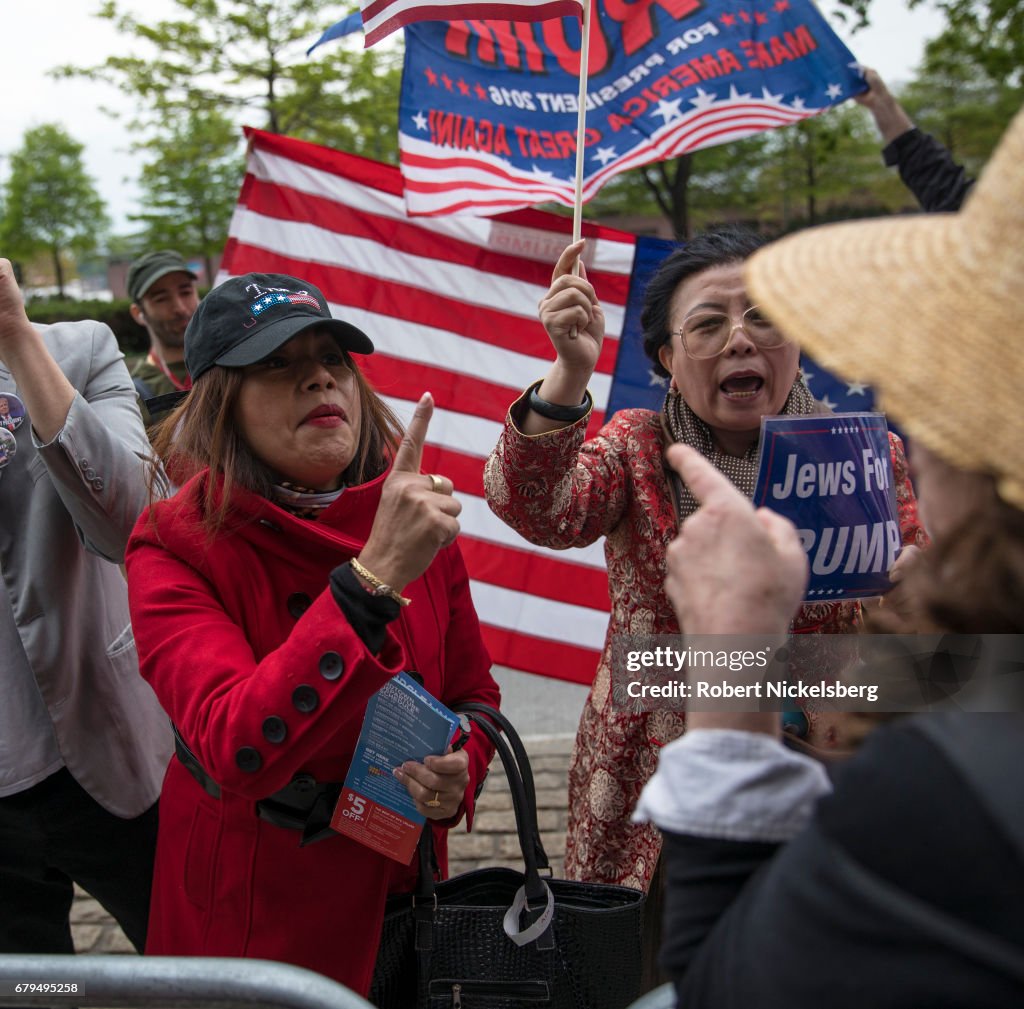
Two women stand in front of American flags and wag their fingers at a person standing close to them on the street.
Supporters of then-President Donald Trump clash with anti-Trump protesters in New York City in 2017. Robert Nickelsberg/Getty Images

When disliking another person is a mistake

Suppose Jane, a Democrat, overestimates the likelihood her Republican neighbor Joe takes bad actions or has bad opinions – by whatever Jane considers “bad.” For example, Jane might overestimate Joe’s opposition to gun control – or overestimate how much hostility Joe feels toward her.

These beliefs likely contribute to Jane’s negative feelings toward Joe. If so, since these beliefs are mistaken, then Jane would dislike Joe more than she should – by her own standards.

In fact, people in general have a tendency to make this mistake when disagreeing with others for many reasons. I call this tendency “affective polarization bias,” since it’s a bias toward excessive affective polarization. (“Affective polarization” is the technical term for emotionally hostile polarization.)

To look for evidence of this bias, I review studies of the accuracy of people’s beliefs about opinions held by members of the other political party. I also examine the accuracy of beliefs about the selfishness of choices by people in the other party in experiments with monetary stakes.

My research shows that people are indeed consistently too pessimistic about their partisan counterparts. On both sides, people tend to overestimate the other side’s extremism, hostility, interest in political violence and selfishness. And the most affectively polarized people make the biggest mistakes.

A woman wears a red coat and a face mask that says 'end abortion.' She walks down a hallway with men behind her, also wearing masks.
Rep. Marjorie Taylor-Greene walks in the U.S. Capitol in February 2021. Tasos Katopodis/Getty Images

Explanations

Although “affective polarization bias” is a new term, the concept of undue dislike is intuitive for most people.

The media environment – specifically the proliferation of cable and online news as well as social media – is a common explanation for recent growth in political hostility, and has likely also led to growth in undue dislike.

Citizens are exposed to more polarizing information today than in decades past – not just on cable TV, online, and on social media, but also in person as our social networks offline are particularly ideologically segregated, more so than ever. As a result, people spend more time talking to others who are like-minded about politics, in addition to getting more like-minded news.

Although people don’t believe everything they hear, they do err toward credulity, especially when encountering information they wish to believe is true – like information about the opposition party’s character flaws, since this supports the superiority of our own party.

In the U.S., strengthened partisan identity has been on the rise because of the merging of partisan identities with other identities – like someone’s cultural or ethnic background. This has also increased people’s motivation to hold beliefs demonizing the opposition.

What’s more, there are several other important causes of undue dislike toward our rivals stemming from fundamental cognitive errors.

Overconfidence and naive realism – thinking our tastes are objective truths – make us overestimate the chance that those who disagree with us on just about anything are doing something wrong. As a result we overestimate the other side’s poor judgment and bad motives.

False consensus” can make us overestimate how much others actually agree with us. This in turn makes us too skeptical of the sincerity of people who express different viewpoints.

Last and not least, strategic retaliation in conjunction with our biases, limited memories and limited foresight is a recipe for escalating undue hostility.

Correcting mistakes

The good news is that mistakes can be corrected. We can undo hate. More and more research efforts are underway to better understand these mistakes – and to correct them, with impressive success.

Many different nonprofit groups are also working to bring political opponents together and to correct misconceptions about the other side. Other scholars and organizations are working to make social media less polarizing.

But as infeasible as it might seem, America may need a bipartisan, top-down effort to have a shot at significantly decreasing unwarranted hatred in the short run.

In the meantime, the next time you feel hate – remind yourself it’s probably partly undue.The Conversation


Daniel F. Stone, Associate professor of economics, Bowdoin College

This article is republished from The Conversation under a Creative Commons license. Read the original article.

With Protasiewicz win, Democrats flip the Wisconsin Supreme Court

Key Points
• In last night’s high-stakes state Supreme Court race in Wisconsin, Democratic-aligned Janet Protasiewicz comfortably dispatched former Justice Daniel Kelly, giving liberals a 4-3 majority on the court.
• Compared to some previous Democratic-aligned judges, Protasiewicz had a more “nationalized” voting coalition, although she still carried several Republican-leaning parts of the state.
• A liberal state Supreme Court could revisit redistricting-related matters, to the benefit of Democrats, although there are a lot of moving pieces. With that in mind, we are downgrading our rating for southeastern Wisconsin’s 1st District from Safe Republican to Likely Republican. CONTINUED

Kyle Kondik & J. Miles Coleman, Sabato’s Crystal Ball


The OPINION TODAY email newsletter is a concise daily rundown of significant new poll results and insightful analysis. It’s FREE. Sign up here: opiniontoday.substack

The GOP’s ‘Abusive Relationship’ With Trump

It’s a measure of Donald Trump’s hold on the Republican Party that his unprecedented criminal indictment is strengthening, not loosening, his grip.

Trump was on the defensive after November’s midterm election because many in the GOP blamed voter resistance to him for the party’s disappointing results. But five months later he has reestablished himself as a commanding front-runner in the Republican presidential primary, even as Manhattan District Attorney Alvin Bragg has delivered the first of what could be several criminal indictments against him. …

Trump’s rivals for the nomination still have many months left to formulate a case against him, particularly once the GOP presidential debates begin in August. But for Republicans resistant to Trump, the months since the November midterm have reversed the trajectory of the seasons. As winter began, many were blooming with optimism about moving the party beyond him. Now, as spring unfolds, they are seeing those hopes wither—and confronting the full measure of just how difficult it will be to loosen Trump’s hold on the GOP. CONTINUED

Ronald Brownstein, The Atlantic


The OPINION TODAY email newsletter is a concise daily rundown of significant new poll results and insightful analysis. It’s FREE. Sign up here: opiniontoday.substack

The right to abortion will be secured before the end of the decade

When the right to choose an abortion is on the ballot, it wins. And it will keep winning for the rest of the decade until the right to abortion is secured state by state in all but the deepest red states and the U.S. Supreme Court’s decision is rendered moot.

The latest evidence? On Tuesday, the liberal Milwaukee circuit court judge, Janet Protasiewicz, scored a solid victory over the conservative candidate Daniel Kelly in a race whose outcome would determine the majority on the Wisconsin Supreme Court and pave the way for overturning the 1849 law outlawing abortion. …

As we saw in the 2022 midterms — when the freedom to choose is on the ballot it wins — upending prior voting patterns. The issue today is more real than it was in past races where Democrats always tried to argue its importance. Not surprising. A right withdrawn will always get more attention than a right taken for granted. While we don’t have any exit polls to confirm that abortion was foremost in voters’ minds, the explicit prominence of the issue in Protasiewicz’s campaign and Kelly’s failed attempts to change the topic are evidence that there was one big issue in this race. CONTINUED

Elaine Kamarck, Brookings Institution


The OPINION TODAY email newsletter is a concise daily rundown of significant new poll results and insightful analysis. It’s FREE. Sign up here: opiniontoday.substack

Fox News Poll: Parents increasingly concerned about book banning

Education is a key talking point for politicians these days, and the latest Fox News Poll finds parents are more concerned about book banning than they were last year. Meanwhile, concern for what their kids are being taught in school has decreased, albeit only by a few points. …

When parents are asked about 14 different issues, book banning and school curriculum land in 4th and 6th place respectively. Parents are most concerned about inflation (92%), higher crime rates (88%), and political divisions (78%), followed by book banning and the U.S. banking system (77% each), the amount they pay in taxes (75%), and school curriculum (73%). CONTINUED

Victoria Balara, Fox News


The OPINION TODAY email newsletter is a concise daily rundown of significant new poll results and insightful analysis. It’s FREE. Sign up here: opiniontoday.substack

Republicans don’t think Trump is a saint. But they don’t want him taken down.

The circus has arrived. There’s no telling what happens to former President Trump’s poll numbers now that he’s been indicted and arraigned; we’re in uncharted territory. There are, however, some fairly remarkable clues emerging. …

It’s all just a new iteration of the same pattern we’ve seen since 2015: Trump says or does something, and everyone except the Trump base reacts with “this will take him down.” But it doesn’t. …

It’s clear, though, that once party elites turned to team Trump in the name of winning the 2016 election and staying in the president’s good graces once he was in office, they led the charge on disseminating the team Trump message—that he can do wrong, but he can’t be held accountable for it. The Republican electorate has overwhelmingly and unshakingly supported Trump since his nomination. The only difference this time is that the legal system gets to have its say, and the legal system is not bound to public opinion. CONTINUED

Natalie Jackson, National Journal


The OPINION TODAY email newsletter is a concise daily rundown of significant new poll results and insightful analysis. It’s FREE. Sign up here: opiniontoday.substack